Justice by Caseload: The Public Defender Crisis Is a Political Decision, Not a Staffing Shortage
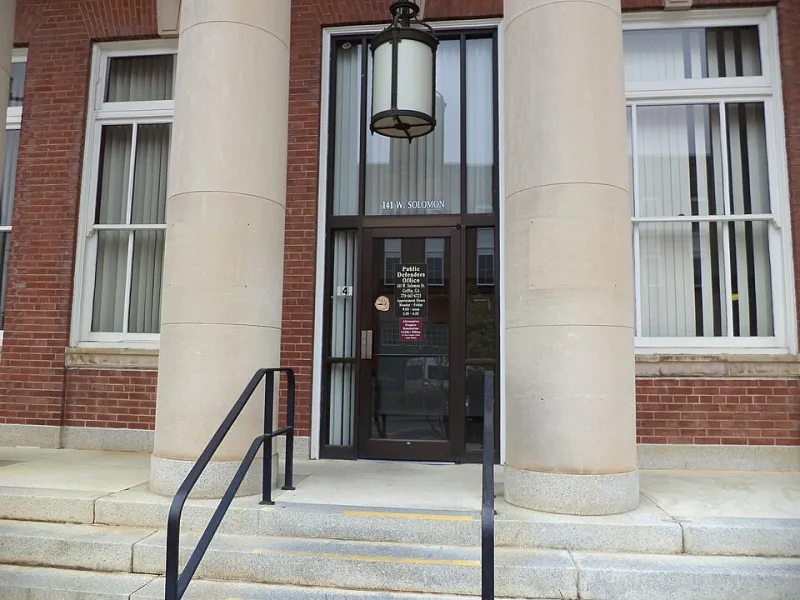
Photo: Michael Rivera, CC BY-SA 3.0, via Wikimedia Commons
A Right That Depends on Your Zip Code
Sixty-three years after Gideon v. Wainwright established that the Constitution requires counsel for defendants who cannot afford a lawyer, the American state has never fully funded the promise it made. The result is not a gap in the system. It is the system's most reliable sorting mechanism, determining who receives a rigorous defense and who receives a folder, an apology, and a thirty-second conversation in a hallway.
We should say plainly what is usually obscured by budget language: the crisis in public defense is a decision. Legislatures have chosen, year after year, to fund prosecution at multiples of what they allocate to defense. Courts have chosen not to enforce workload limits. Local governments have chosen to fund public defense out of court fees rather than general revenue, which is to say they have chosen to make the poor pay for their own defense twice. None of these were natural disasters.
What the Numbers Say
The legal profession has known for decades what constitutes an excessive caseload. The American Bar Association's formal opinion on excessive workloads treats it as an ethical matter, not merely a management inconvenience: a lawyer with too many cases cannot provide competent representation, and continuing to accept new clients under such conditions is a professional violation. The ABA's Ten Principles of a Public Defense Delivery System, issued in 2002, states the same requirement in institutional terms — caseloads must be controlled by workload standards, not by the willingness of executives to run their offices into the ground.
The Bureau of Justice Statistics' census of public defender offices found, more than fifteen years ago, that a substantial share of offices were exceeding recognized caseload limits. State audits and judicial studies since then have documented the same pattern with depressing regularity: felony caseloads three to five times the recommended maximum in some jurisdictions, misdemeanor dockets that resemble triage tents rather than legal practice. Offices in Louisiana, Missouri, Oregon, New Mexico, Nevada, and elsewhere have at various points reported vacancy rates and attrition severe enough to be described in court filings as constitutionally unmanageable.
These are averages, and averages conceal the point. Behind each of them is a named person who was told their attorney would be a stranger for the eleven minutes available.
How a Caseload Becomes a Coercive Plea
Because roughly ninety-five percent of criminal convictions in the United States are obtained by plea rather than trial, the quality of defense is decided mostly in the negotiation. That is where a public defender with two hundred open files becomes structurally unable to do the work Gideon presumed. A lawyer cannot investigate an arrest, obtain discovery, interview witnesses, retain an expert, and litigate suppression on that schedule. What remains is an offer, a calculation, and a signature.
This is where the coercion lives. A prosecutor's offer of time served, or of a plea that avoids a mandatory minimum, is not presented as a threat — and often is not intended as one. But when the alternative is a year of pretrial detention awaiting a trial your lawyer has told you she cannot adequately prepare, the plea bargain is not a bargain. It is a forced sale, priced by the state, executed on a courthouse elevator.
Dr. Ambedkar argued that equality before the law is meaningless if the machinery of law is rationed. He was describing a caste society in which the poor man's case was heard with less attention than the rich man's. The mechanism differs on this side of the ocean. The outcome does not.
The Quiet Fiscal Argument
If this were a genuine staffing emergency, states would respond with the tools used for emergencies: emergency appropriations, accelerated training pipelines, loan repayment programs, and mandated hiring. Those tools are used for police departments, prosecutorial offices, and corrections. Public defenders are asked to solicit donations, chase fee reimbursement from clients who have no money, and absorb one more case.
The funding architecture tells us the rest. Where defense is financed by court fees, its budget rises only when arrests rise. Where it is financed by county general funds capping caseloads, it competes with everything else. In neither structure is anyone rewarded for building a defense capacity sufficient to make the state prove its case — and there is no political constituency, on the fiscal right, that wants to pay for a defendant's advantage.
The absence of a constituency shows what the choice really is. We are not failing to fund public defense for lack of money. We are declining to fund it because a well-resourced defense is politically inconvenient for everyone whose authority depends on the current conviction rate.
Workload Standards With Teeth
What would it take to make the right to counsel real? First, enforceable standards, which means statutes and court rules rather than voluntary norms. A cap on the number of cases an attorney may carry — differentiated by case type and severity — that triggers relief when exceeded, whether by appointment of additional counsel, reduction of appointments, or dismissal of the case without prejudice. Courts must be empowered and required to find a way, not to plead congestion.
Second, structural funding, meaning defense paid from state general revenue rather than fee recovery and municipal budgets, with the fiscal authority separated from the judicial and prosecutorial offices it opposes.
Third, independence, meaning public defender offices led by elected or independently appointed chief defenders, accountable to a board rather than to the county commission which funds them.
Fourth, transparency, meaning caseload data published quarterly at the office level, so that workload is a public fact rather than an anecdote attorneys can be disciplined for repeating.
Community Oversight as the Missing Ingredient
Every reform above can be defeated in a budget hearing. That is why the organizing matter is the oversight dimension. In cities that have experimented with public defense commissions — including former defenders, affected families, and community organizations — the structural difference is not merely moral. It is that someone with standing to speak before a fiscal body can testify that the eleven-minute meeting would be acceptable in a hearing on any other public service without being dismissed as interested.
The police have unions. The incarcerated have nothing but organizers. Building a permanent civic constituency for a well-funded defense is the single most durable reform available, and it is the one nobody wants to pay for.
What We Owe Gideon
An underfunded defense is not a technical defect we are slowly correcting. It is the practice of the American state, made explicit in appropriations, that constitutional rights are proportionate to income. A system that offers a lawyer the way a hospital offers a bed is a rationed profession. The alternative is not expensive relative to what prisons cost. It is simply expensive to the people who currently benefit from the ration.
Defense is not a subsidy to be cut. It is the state's obligation to prove its own case before it takes a person's liberty. Fund it accordingly — and enforce the limit that prevents courage from being squandered on an unpayable caseload.