Stolen Futures: How the Demolition of Defined-Benefit Pensions Engineered a Retirement Crisis — and How Workers Are Pushing Back
A Quiet Confiscation That Took Forty Years
There was no single moment when American workers lost their retirement security. There was no dramatic heist, no masked figure absconding with the vault. Instead, the transfer happened incrementally, legislatively, and with the full cooperation of policymakers who were persuaded — or paid — to look the other way. By the time most workers understood what had occurred, the architecture of collective retirement protection had been largely dismantled, replaced by a system that placed virtually all investment risk squarely on the shoulders of individuals least equipped to absorb it.
For much of the twentieth century, defined-benefit pension plans served as a cornerstone of working-class financial security in the United States. Under this model, an employer assumed responsibility for funding a guaranteed monthly income in retirement, calculated according to years of service and salary history. Workers contributed their labor; employers assumed the actuarial risk. The arrangement was not charity — it was a negotiated compact, often won through collective bargaining, that recognized retirement security as a legitimate component of worker compensation.
Then came the 1980s, and with them a systematic corporate campaign to dissolve that compact.
The 401(k) Switcheroo
The Revenue Act of 1978 contained an obscure provision — Section 401(k) — that initially attracted little attention. Within a few years, however, benefits consultants and corporate executives recognized it as a vehicle for restructuring the entire relationship between employers and employee retirement. Rather than funding guaranteed pensions, companies could now offer workers tax-advantaged savings accounts into which employees contributed their own wages, with employers providing modest matching contributions at their discretion.
The sales pitch was seductive: workers would gain control over their own retirement destinies, choosing their own investments and building personal wealth in the stock market. What the pitch omitted was equally significant. Workers were being handed not merely an opportunity but an obligation — the obligation to become sophisticated investors navigating volatile markets without the actuarial expertise, institutional scale, or risk-pooling capacity that defined-benefit plans had provided.
The results have been catastrophic for the working class. According to data from the Federal Reserve, the median retirement account balance for Americans approaching retirement age hovers around $87,000 — a figure that would sustain perhaps three to four years of modest living, not the twenty or thirty years a retiree might require. Meanwhile, the wealthiest ten percent of households hold roughly eighty percent of all financial assets, including retirement accounts. The 401(k) did not democratize wealth accumulation; it concentrated it.
The Racial Geometry of Pension Destruction
The collapse of defined-benefit pensions has not been racially neutral. Black and Latino workers, who were frequently excluded from union membership and employer pension plans during the mid-twentieth century, were just beginning to access these systems in meaningful numbers when corporations began dismantling them. The timing was not coincidental. Pension erosion compounded existing racial wealth gaps rather than ameliorating them, ensuring that communities who had only recently gained access to structured retirement security would again be left without it.
Dr. B.R. Ambedkar, whose intellectual legacy animates the mission of this publication, understood that economic exclusion and social hierarchy are never accidental byproducts of neutral systems — they are structural features of arrangements designed to preserve existing hierarchies of power. The pension crisis is a contemporary illustration of that principle. When corporations shed retirement obligations, the burden fell most heavily on those whose political power was most limited and whose historical access to wealth-building mechanisms had been most constrained.
Public-sector pension systems, which disproportionately cover Black workers who have long been steered toward government employment, have faced particularly aggressive attack. State legislatures in Illinois, New Jersey, Kentucky, and elsewhere have systematically underfunded public pension obligations, creating crises that are then used to justify benefit cuts affecting teachers, sanitation workers, transit employees, and healthcare aides — workforces that are disproportionately composed of workers of color.
The Organized Response
The story does not end with dispossession. Across the country, workers, community organizations, and advocacy coalitions have begun constructing a serious challenge to the retirement security status quo.
In California, labor unions representing public employees have fought sustained legal and legislative battles to protect defined-benefit structures from privatization advocates who frame pension obligations as fiscal irresponsibility. The California Public Employees' Retirement System (CalPERS) and the California State Teachers' Retirement System (CalSTRS) remain among the largest and most politically consequential institutional investors in the world — a fact that pension justice advocates have leveraged to push for socially responsible investment policies that align retirement fund management with the interests of the communities those funds are meant to serve.
At the federal level, advocacy organizations including the Pension Rights Center have campaigned for years to strengthen the Employee Retirement Income Security Act (ERISA) and close the loopholes that allow employers to reduce or eliminate pension obligations through bankruptcy proceedings and plan terminations. The Butch Lewis Emergency Pension Plan Relief Act, signed into law in 2021, represented a significant — if partial — victory, directing federal relief to multiemployer pension plans on the verge of collapse and protecting the retirement income of approximately three million workers and retirees.
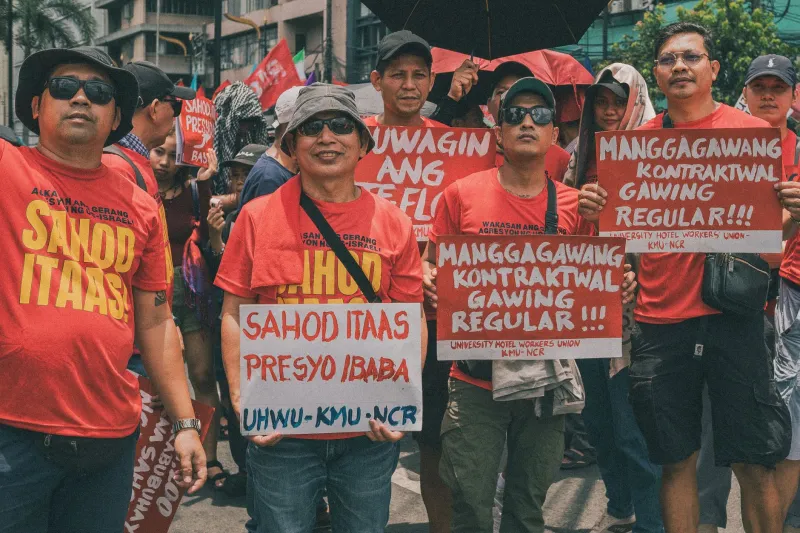
Grassroots organizing has also taken creative forms. In Chicago, community groups connected to the broader movement for economic justice have organized pension town halls in Black and Latino neighborhoods, translating the complexity of actuarial policy into accessible conversations about what retirement insecurity means for families and communities. These efforts recognize that pension policy, like all economic policy, is ultimately a question of political power — and that building political power requires building informed, engaged communities.
What Genuine Reform Would Require
Restoring retirement security to the American working class is not a technical problem awaiting a technocratic solution. It is a political problem that requires confronting the concentrated corporate power that dismantled the previous system in the first place.
Meaningful reform would include mandatory employer contributions to portable defined-benefit plans, enforceable through federal legislation rather than left to the vagaries of collective bargaining in a landscape where union density has been systematically suppressed. It would require full funding requirements for existing pension obligations, with real penalties for states and municipalities that use underfunding as a pretext for benefit cuts. It would demand the expansion of Social Security — the one genuinely universal retirement program the United States possesses — rather than its perpetual exposure to privatization schemes that would replicate the 401(k) disaster on a national scale.
Perhaps most fundamentally, it would require acknowledging that retirement security is not a personal responsibility to be managed through individual financial discipline. It is a collective obligation — one that a just society distributes across employers, workers, and the public in a manner that does not leave the most vulnerable to absorb the most risk.
The Stakes of the Struggle
Pension justice is not a narrow labor issue. It is a civil rights issue, an economic justice issue, and a question of what kind of society we intend to build. When workers reach the end of their productive years without adequate income, they do not simply experience personal hardship — they become dependent on family members who are themselves financially precarious, they withdraw from civic life, and they pass on diminished circumstances to the next generation.
The intergenerational transmission of poverty and insecurity is precisely the mechanism by which structural inequality reproduces itself across time. Ambedkar recognized that annihilating caste required dismantling the economic arrangements that sustained it. In the American context, dismantling the retirement security crisis requires the same clarity of vision: understanding that the pension heist was not a market correction but a political act, and that reversing it will require organized political power capable of confronting those who benefited from the theft.