Indentured Entrepreneurs: How the Franchise Model Converts the American Dream Into Corporate Bondage

The Promise Sold at Every Franchise Expo
Walk into any franchise exposition in Chicago, Houston, or Atlanta and the pitch is remarkably consistent: buy into a proven system, leverage an established brand, and build generational wealth on your own terms. Recruiters speak the language of entrepreneurship, self-determination, and community investment. For immigrants, veterans, and working-class families who have spent decades locked out of conventional capital markets, the franchise model presents itself as the rare ladder that actually reaches the ground floor.
The reality waiting inside those agreements tells a profoundly different story.
Across the United States, an estimated 790,000 franchise establishments employ roughly 8.4 million workers and generate hundreds of billions in economic output annually. Yet the entrepreneurs who operate these locations — the franchisees who mortgage their homes, liquidate retirement accounts, and invest years of labor — often discover that the wealth they generate flows reliably upward while their own margins erode beneath a cascade of mandatory fees, unilateral policy changes, and contract terms that would make any labor attorney wince.
Anatomy of an Asymmetric Contract
The standard franchise disclosure document, required under the Federal Trade Commission's Franchise Rule, can run hundreds of pages. Within those pages lies a structural imbalance so consistent across industries that it reads less like coincidence and more like architecture.
Consider what a typical franchise agreement actually grants the corporate franchisor: the unilateral right to alter operational standards, mandate expensive equipment upgrades, approve or reject suppliers, set pricing floors or ceilings, audit financial records at will, and terminate the agreement for an expanding list of compliance failures — all without meaningful recourse for the franchisee. The franchisee, by contrast, assumes complete liability for employment law violations, workplace injuries, and local regulatory compliance, even when the policies driving those violations originate from corporate headquarters.
This is not a partnership. It is a hierarchy with legal paperwork.
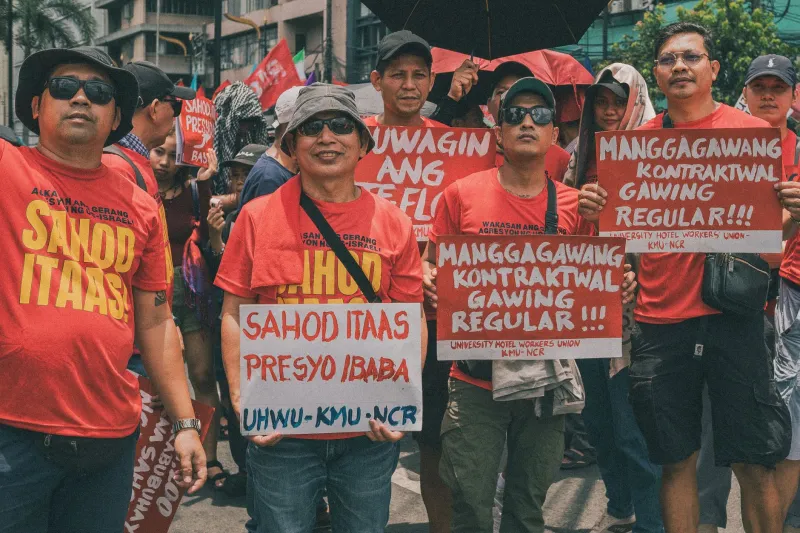
Fast-food workers and labor advocates have long understood that the franchise structure creates a convenient buffer for major corporations. When workers at a McDonald's or a Domino's location organize for better wages, the corporate entity deflects responsibility to the franchisee. When the franchisee attempts to raise prices to fund those wages, corporate policy constrains their flexibility. The worker is trapped. The franchisee is trapped. The corporation, insulated by layers of contractual distance, absorbs the profits.
The Caste Logic of Capital Concentration
Dr. B.R. Ambedkar's analysis of caste did not limit itself to social discrimination. He understood caste as an economic mechanism — a system designed to confine certain groups to fixed positions in the labor hierarchy while ensuring that surplus value migrated reliably to those positioned at the top. The franchise model, stripped of its marketing language, replicates this logic with striking fidelity.
Franchisees are disproportionately drawn from communities that have historically faced exclusion from conventional business financing: South Asian immigrants, African American entrepreneurs, Latino families building first-generation wealth. The franchise system presents itself to these communities as an accessible entry point into business ownership. What it frequently delivers instead is a position that carries all the risk of ownership with few of the freedoms — a status that is neither employee nor true proprietor, but something deliberately in between.
The International Franchise Association, the industry's primary lobbying body, has spent considerable resources opposing legislation that would expand joint-employer liability — the legal standard that would hold corporate franchisors accountable for labor conditions in their branded locations. That opposition is not incidental. It is the system defending itself.
Franchisee Organizing: Cracks in the Hierarchy
What is most significant about recent years is not the persistence of these inequalities but the organized resistance beginning to confront them.
Franchisee associations — once rare and often discouraged by corporate entities — are proliferating across sectors. The American Association of Franchisees and Dealers has pushed for legislative reforms in multiple states, advocating for good-cause termination protections that would prevent corporations from non-renewing franchisees arbitrarily after those operators have spent years building customer bases and community relationships. In California, legislative battles over fast-food worker standards brought franchisees and workers into unexpected alignment, with some operators acknowledging that corporate pricing constraints, not their own choices, were the primary obstacle to raising wages.
In the convenience store sector, independent franchisee associations have challenged unilateral fee increases through coordinated legal action. In the hotel industry, South Asian American franchisee groups — representing a community that owns a remarkable share of American hotel properties — have organized explicitly around contract equity, recognizing that brand power cannot be a license for perpetual extraction.
These efforts are not yet a movement in the full sense. They remain fragmented, often operating without the institutional infrastructure that labor unions or civil rights organizations have built over generations. But the organizing instinct is present, and the analysis is sharpening.
What Reform Would Actually Require
The path toward genuine franchisee equity runs through several interconnected reforms, none of which will emerge from industry self-regulation.
First, federal franchise disclosure requirements must be strengthened to include plain-language summaries of termination rights, fee escalation histories, and documented litigation records — information currently buried in formats designed to overwhelm rather than inform.
Second, good-cause termination and renewal protections must become federal baseline standards, not patchwork state-by-state experiments. A franchisee who has invested hundreds of thousands of dollars and a decade of labor into building a business deserves more than a sixty-day termination notice delivered at corporate discretion.
Third, joint-employer standards must be restored and strengthened so that corporations cannot simultaneously exercise operational control over franchised locations while escaping accountability for the labor conditions that control produces.
Finally, franchisee organizing must receive the same legal protections afforded to other forms of collective action. The antitrust exemptions that have historically been used to discourage franchisee associations from coordinating on pricing or contract negotiations deserve serious reexamination in light of the power asymmetries they protect.
Solidarity Across the Counter
The most promising development in this space is the growing recognition among franchisees and franchise workers that their interests, while not identical, are more aligned than the corporate structure would prefer. When a fast-food worker organizes for a living wage and a franchisee operator acknowledges that corporate royalty structures make that wage impossible to fund, both parties are identifying the same upstream extraction.
Ambedkar's vision was never limited to the liberation of a single class. It was a systemic critique of hierarchies that manufactured dependency, confined aspiration, and concentrated power through legal and economic mechanisms rather than through open coercion. The franchise trap is precisely such a mechanism — sophisticated in its design, normalized through repetition, and sustained by the silence of those who have been persuaded that their chains are, in fact, a business opportunity.
Breaking that silence is where every movement begins.